You are planning a new commercial building or replacing an old HVAC system, and you are staring at two very different options: a rooftop unit or a split system. The HVAC contractor is throwing around technical terms, the cost estimates are all over the place, and you are trying to figure out which one actually makes sense for your building.
The truth is that both systems work, but they work differently and they fit different situations. Choosing the wrong one can cost you more upfront, cost you more in maintenance over time, or create problems down the road.
In this article, we are going to break down the differences between rooftop units and split systems, explain when each one makes sense, and give you the information you need to make the right call for your building.
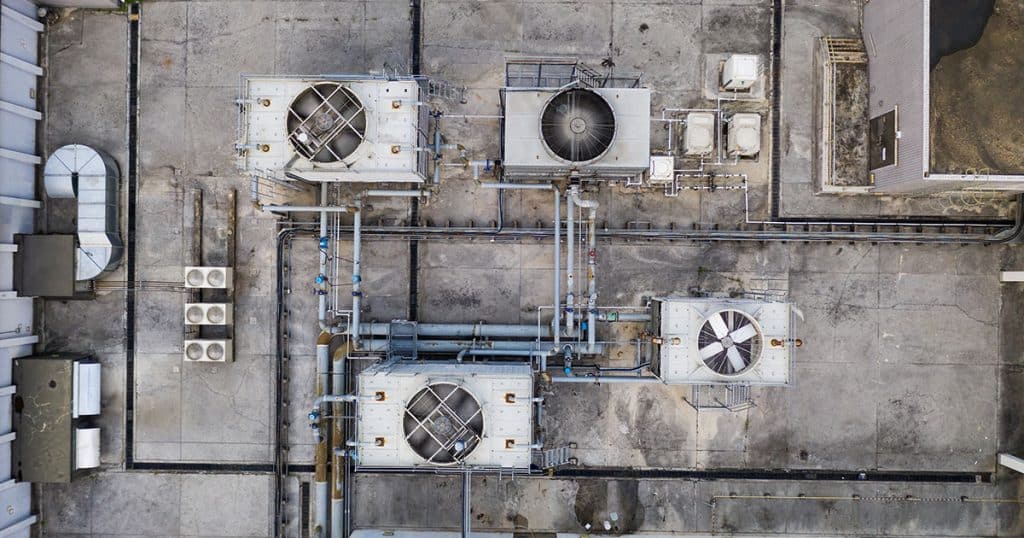
A rooftop unit, also called an RTU or packaged unit, is a self-contained HVAC system that sits on the roof of a commercial building. Everything you need for heating and cooling is in one box: the compressor, the condenser, the evaporator, the blower, and the controls. Ductwork runs from the rooftop unit down into the building to deliver conditioned air.
Rooftop units are extremely common in commercial buildings. If you have ever been in a retail store, office building, or restaurant, there is a good chance it was cooled by a rooftop unit. They are designed for commercial use and are built to handle the demands of larger spaces and longer operating hours.
A split system separates the components into two parts: an outdoor unit and an indoor unit. The outdoor unit contains the compressor and condenser, and it sits on a concrete pad outside the building. The indoor unit contains the evaporator and blower, and it is usually mounted in a mechanical room, attic, or closet. Refrigerant lines and electrical connections run between the two units.
Split systems are common in both residential and smaller commercial buildings. They are versatile and can be configured in many ways depending on the building layout and cooling needs.
Here are the main differences that affect how each system performs and which one makes sense for your building.
Rooftop units sit on the roof, which frees up ground-level space. This is a big advantage for buildings with limited outdoor space or buildings where you do not want equipment visible from the street. The roof becomes your mechanical space, and you do not lose any usable square footage inside or outside the building.
Split systems require space both inside and outside. The outdoor unit needs a concrete pad on the ground, and the indoor unit needs space in a mechanical room, attic, or closet. If you have limited roof access or a structural roof that cannot support heavy equipment, a split system might be the better choice.
Rooftop units are typically easier and faster to install because everything is self-contained. The unit is craned onto the roof, connected to the ductwork, wired for power, and you are done. There are no refrigerant lines to run between indoor and outdoor units, which simplifies the installation.
Split systems require more labor to install because you have to run refrigerant lines, electrical connections, and a condensate drain between the indoor and outdoor units. The installation is more involved, which usually means higher labor costs.
Rooftop units are out of sight, which some building owners like, but they also require roof access for maintenance. Technicians need to get up on the roof safely, which can be challenging in bad weather or on tall buildings. However, because everything is in one location, maintenance is straightforward once you are up there.
Split systems are easier to access because the outdoor unit is on the ground and the indoor unit is usually in a mechanical room or attic. No ladders, no roof access, and technicians can service the equipment in any weather. This can mean faster service calls and lower maintenance costs over time.
Rooftop units are quieter from the perspective of people inside or around the building because the compressor and condenser are on the roof. You do not hear the outdoor noise that you would with a ground-level unit.
Split systems have the compressor and condenser at ground level, which can be noisy. If the outdoor unit is near a window, patio, or neighboring property, noise can be an issue. Proper placement and sound barriers can help, but it is something to consider.
Both systems can be energy efficient, but there are some differences. Rooftop units are exposed to the elements, which means they work harder in direct sunlight and extreme heat. In Florida, where roofs can reach 160 degrees or more in summer, this can reduce efficiency slightly.
Split systems have the outdoor unit at ground level, which is typically cooler than a rooftop. The indoor unit is in a conditioned or semi-conditioned space, which can improve efficiency. However, longer refrigerant lines in a split system can reduce efficiency if not installed properly.
Rooftop units are the go-to choice for many commercial buildings, especially in the following situations.
Rooftop units are ideal for large, open commercial spaces like retail stores, warehouses, gyms, or office buildings with open floor plans. They are designed to handle high cooling and heating loads and can efficiently serve large areas with a single unit.
If you do not have space for outdoor equipment on the ground, or if you do not want equipment visible from the street, a rooftop unit solves that problem. The roof becomes your mechanical space, and you preserve outdoor areas for parking, landscaping, or customer use.
If you are building new or replacing a roof, it is a good time to install a rooftop unit because the roof can be structurally designed to support the equipment. Retrofitting a rooftop unit onto an older building requires a structural assessment to make sure the roof can handle the weight.
If your building already has ductwork running from the roof down into the space, a rooftop unit is a natural fit. The ductwork is already in place, and you avoid the cost of relocating it.
Split systems are a better choice in certain situations, especially for smaller or more complex buildings.
For smaller commercial buildings, individual tenant spaces, or buildings with multiple tenants that need separate temperature control, split systems offer more flexibility. You can install multiple smaller split systems instead of one large rooftop unit, giving each space independent control.
If your roof cannot support the weight of an HVAC unit, or if roof access is difficult or unsafe, a split system is the practical choice. The outdoor unit sits on a concrete pad at ground level, and the indoor unit can be installed in an attic, mechanical room, or closet.
When renovating an existing building, a split system is often easier to retrofit because you do not need to reinforce the roof or install a crane to lift equipment. The components can be brought in through normal doors and installed in stages.
If noise from an outdoor unit would be a problem for neighbors, outdoor seating areas, or adjacent properties, a split system can be positioned away from those areas or behind sound barriers. A rooftop unit keeps noise out of earshot entirely.
The cost of each system depends on the size of the building, the complexity of the installation, and local labor rates. Here is a general comparison.
Rooftop units typically cost more upfront because the equipment itself is more expensive and requires a crane for installation. However, the installation is faster, which can offset some of the labor cost. A rooftop unit for a small to medium commercial building might range from $8,000 to $20,000 or more installed, depending on capacity.
Split systems generally have a lower equipment cost, but installation labor can be higher because of the need to run refrigerant lines and connect the indoor and outdoor units. A split system for a similar-sized space might range from $6,000 to $15,000 or more installed.
Rooftop units can be more expensive to maintain because of the need for roof access, but the maintenance itself is straightforward. Split systems are easier and faster to access, which can mean lower service costs over time. Regular commercial HVAC maintenance is essential for both systems to maximize lifespan and efficiency.
Both systems can last 15 to 20 years with proper maintenance. Rooftop units are exposed to more weather and UV damage, which can shorten lifespan slightly if not well-maintained. Split systems may last longer in some cases because the indoor components are protected from the elements.
Here are the questions to ask when deciding between a rooftop unit and a split system.
A qualified commercial HVAC contractor can assess your building, explain the pros and cons of each option, and recommend the system that makes the most sense for your situation.
At ABS Heating and Air, we have experience installing and servicing both rooftop units and split systems for commercial buildings throughout the Ocala area. We can assess your building, explain your options, and help you choose the system that fits your needs and budget.
We handle the entire process, from load calculations and system sizing to permitting, installation, and startup. You get a system that is properly installed and ready to perform from day one.
If you are planning a new building, replacing an old system, or just trying to figure out what makes sense for your property, give us a call. We will come out, take a look, and give you an honest recommendation.
Rooftop units and split systems both have their place in commercial HVAC. Rooftop units are ideal for large open spaces, buildings with limited ground space, and situations where you want equipment out of sight. Split systems work better for smaller buildings, multi-tenant spaces, buildings with weak or inaccessible roofs, and situations where you need flexibility or easier service access.
There is no one-size-fits-all answer. The right choice depends on your building, your budget, and your priorities. A good contractor will help you weigh the options and choose the system that makes the most sense for your situation.
Both can be energy efficient, but split systems may have a slight edge in Florida because the outdoor unit is at ground level and not exposed to extreme rooftop heat. However, a properly sized and maintained rooftop unit can be just as efficient. Efficiency depends more on system design, installation quality, and maintenance than on system type.
Yes, but the roof must be structurally sound enough to support the weight of the equipment. A structural engineer or contractor should assess the roof before installation. If the roof cannot support the unit, reinforcement may be required, or a split system may be a better option.
The cost depends on the size and capacity of the unit, but a typical rooftop unit for a small to medium commercial building might range from $8,000 to $20,000 or more installed. Larger buildings or more complex installations will cost more.
Split systems are generally easier to access because the outdoor unit is on the ground and the indoor unit is in a mechanical room or attic. Rooftop units require roof access, which can be more challenging, especially in bad weather or on tall buildings. However, both systems need regular maintenance to perform well.
Yes. If you have a building with multiple zones or tenant spaces that need independent temperature control, multiple smaller split systems can work better than one large rooftop unit. This gives each space its own thermostat and avoids conflicts over temperature settings.
Both can last 15 to 20 years with proper maintenance. Rooftop units are exposed to more weather and sun, which can reduce lifespan if not well-maintained. Split systems may last slightly longer because the indoor components are protected. Regular maintenance is the biggest factor in extending the life of either system.